

DAC hubs in Louisiana and Texas back on track, testing three technologies
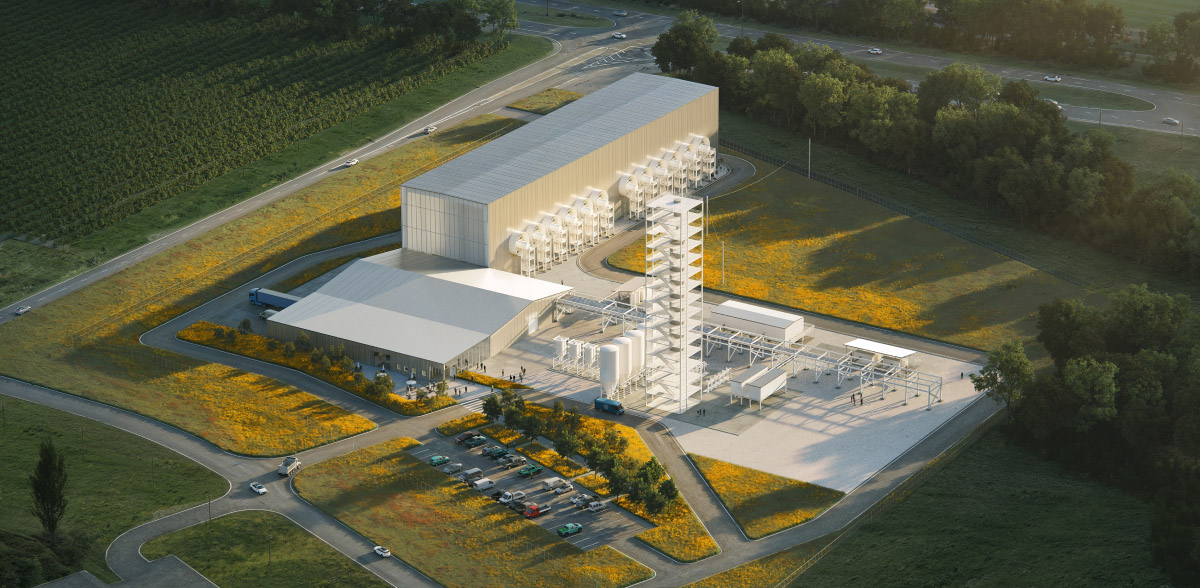
The outlook for two large-scale DAC hubs — the Project Cypress Regional DAC Hub and the South Texas DAC Hub — has shifted from uncertainty to cautious optimism following new federal guidance.
The projects had been in limbo since May 2025, when the U.S. Department of Energy postponed the release of roughly $1.2 billion in grants pending a technical review of those awards and approximately 2,000 others issued under the previous administration.
With funding now appearing likely, project design and operational plans are coming back into focus. Both hubs are located in oil- and gas-producing regions underlain by thick sandstone formations that can serve as underground storage reservoirs for captured CO2.
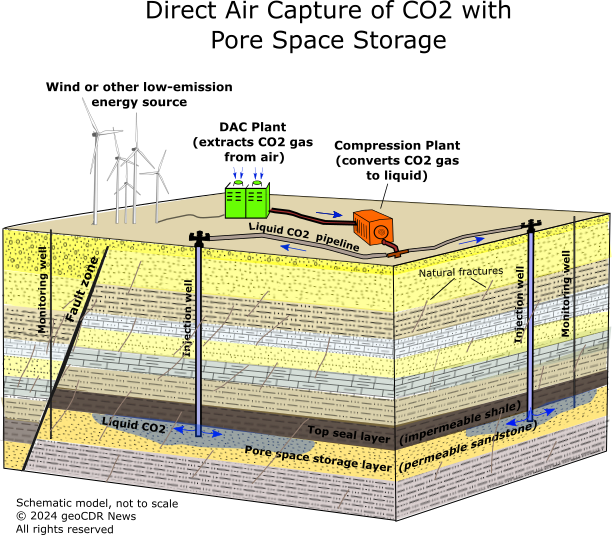
A DAC hub is a network of direct air capture facilities that includes DAC plants, CO2 transport infrastructure, subsurface storage resources with injection systems, and potential CO2 users. Hubs may also handle CO2 captured from industrial sources in addition to atmospheric capture.
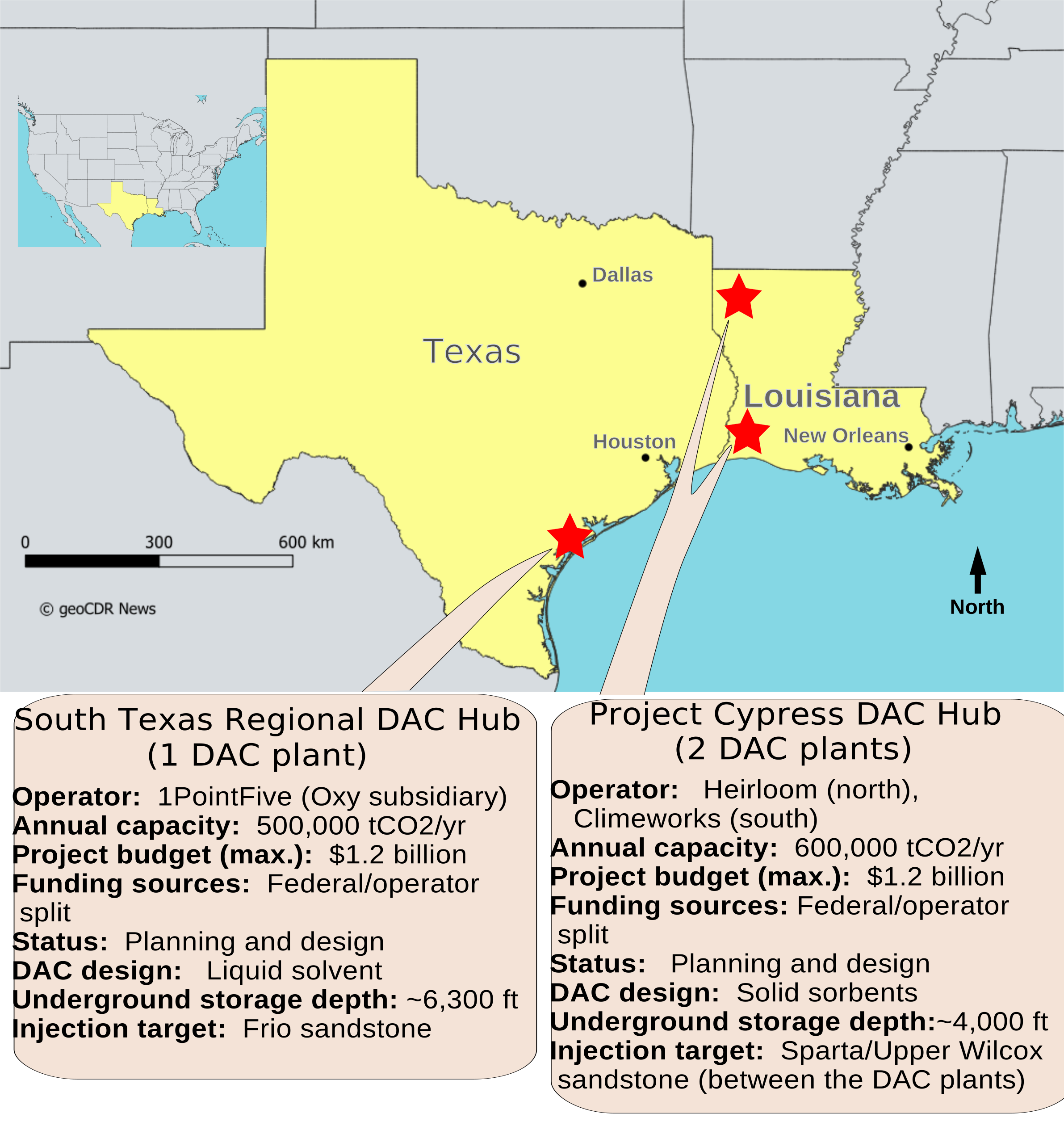
Project Cypress DAC Hub
Project Cypress is planned as two DAC plants in western Louisiana, one operated by Heirloom Carbon Technologies, Inc. and one operated by Climeworks Corporation.
San Francisco-based Heirloom operates a pilot DAC plant in Tracy, California (USA) with capture capacity of 1,000 . The captured CO2 is incorporated into cement at a nearby cement plant.
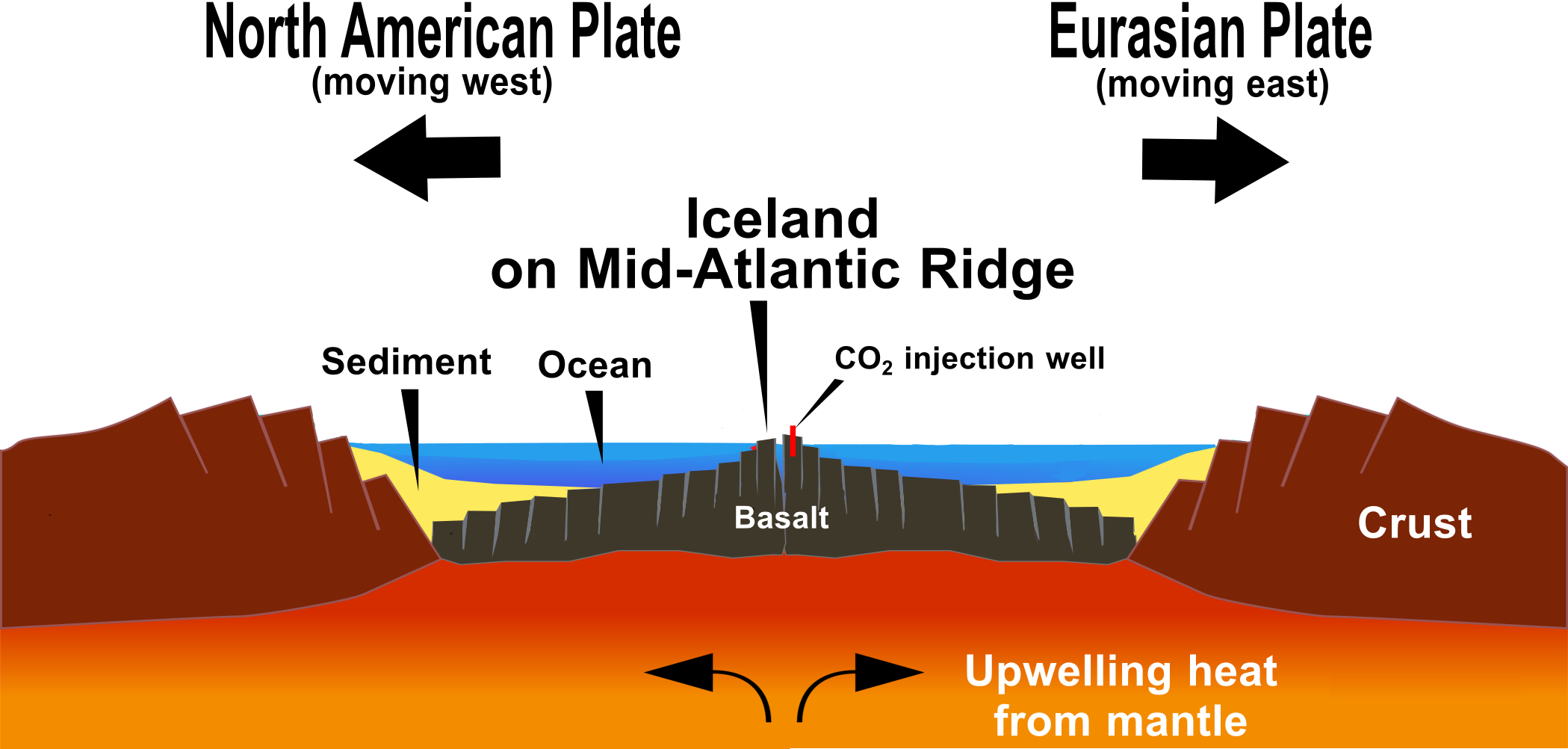
Zurich, Switzerland-based Climeworks operates the Mammoth and Orca DAC plants in Iceland. Mammoth was the first large-scale DAC plant ever built, although only a fraction of its 36,000- nameplate capacity has been achieved. CO2 at Mammoth is injected underground into basalt where it reacts to form a limestone-type of rock.
Project Cypress is being planned for an initial CO2 capture capacity of about . The project’s budget of up to for design and construction is to be shared between DOE and the two operators.
Each operator will construct a 300,000 tCO2/yr DAC plant in the first phase, with plans to expand the hub to 1 million tCO2/yr. The non-profit engineering and design firm Battelle serves as project lead.
in the first phase is expected to total about 1,800 temporary construction jobs and roughly 220 permanent positions during operations. Carbon credit sales and the $180/ton 45Q federal tax credit are expected to support ongoing operations.
Project Cypress also comes amid growing concern in Louisiana about CO2 pipeline safety, underground storage risks, and the use of eminent domain. The state holds regulatory authority over CO2 injection wells.
South Texas DAC Hub
The South Texas DAC Hub is planned with one DAC plant operated by 1PointFive, a subsidiary of Occidental Petroleum Corporation.
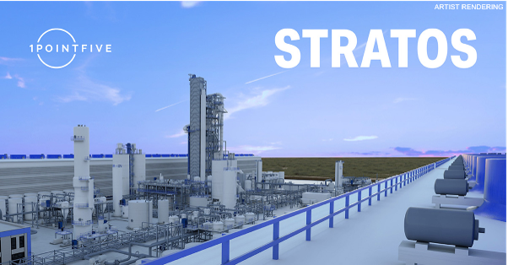
1PointFive is in the final stages of starting up what will be the world’s largest DAC plant — STRATOS — in West Texas. STRATOS is designed for 500,000 tCO2/yr, with underground injection expected to begin in 2026.
The planned capacity of 1PointFive’s initial South Texas DAC plant is , with expansion to 1 million tCO2/yr and long-term ambitions of up to 30 million tCO2/yr across the hub.
The budget for the initial plant is about $1.2 billion, shared equally between DOE and Oxy. 1PointFive’s website indicates that its DAC facilities typically employ more than 1,000 construction workers and about 120 permanent workers during operations. Carbon credit sales and the $180/ton 45Q tax credit are expected to support operations.
Three DAC approaches, one goal
Climeworks, Heirloom, and 1PointFive all aim to remove CO2 from ambient air, but their technologies differ significantly.
- Climeworks uses a structured solid sorbent that captures CO2 and releases it when heated to about 100°C.
- Heirloom uses a that heats limestone (CaCO3) to about 900°C to produce calcium oxide, which is then hydrated to form calcium hydroxide that absorbs CO2, reforming limestone.
- 1PointFive uses a process developed by Carbon Engineering that captures CO2 in a potassium hydroxide solution and regenerates the solvent through a calcium loop and high-temperature calcination.
These design choices drive energy demand. Climeworks relies on lower-temperature heat and electrically driven systems, while Heirloom and 1PointFive depend on high-temperature calcination, which dominates their energy use.
Water use also differs. 1PointFive’s system relies heavily on aqueous chemistry, while Heirloom uses water in its hydration step but may benefit from humid conditions. Climeworks generally presents its solid-sorbent system as more water-efficient, though local conditions still matter.
For carbon removal buyers and policymakers, the key takeaway is that direct air capture is not a single technology. These approaches span a spectrum from engineered filters to mineral looping systems to liquid chemical processes, with implications for cost, siting, and scalability.
Underground storage
CO2 captured at Project Cypress will be transported by pipeline to a storage site operated by . The company has applied for permits for 12 injection wells targeting the Upper Wilcox and Sparta sandstone formations at depths below about , sealed by overlying shale layers.
At the South Texas hub, CO2 will be injected into the Frio sandstone formation at depths below . The site is located on the King Ranch, and applications for six injection wells are under review by the Texas Railroad Commission.
Going forward
Design, construction, and optimization of the two hubs may take as long as 12 years. With funding now moving forward, the projects will serve as early large-scale tests of the DAC technologies and the hub model itself.