

Five key takeaways from the newly published 3rd Edition of The State of Carbon Dioxide Removal
The "State of Carbon Dioxide Removal" report has become one of the most widely cited assessments of the carbon removal sector since its first edition was published in 2023. Produced by an international consortium of researchers and updated regularly, the report tracks developments in carbon removal research, policy, markets, and deployment worldwide.
The newly released third edition provides the latest snapshot of how quickly carbon removal is scaling—and how far it still has to go to support global climate goals.
1. Carbon removal is no longer optional
Climate scientists have increasingly concluded that cutting emissions, while essential, will not by itself achieve long-term climate goals. The report argues that removing some carbon already in the atmosphere will be necessary even if countries sharply reduce future emissions.
Across Paris-compatible climate scenarios, emissions reductions provide at least 80% of the effort needed to reach net zero, while carbon removal supplies the remainder. The report warns against treating carbon removal as an alternative to cutting emissions at their source.
2. Almost all carbon removal today comes from forests and soils
Global carbon removal currently totals about 2.2 billion tonnes of CO2 per year, equivalent to roughly 5% of annual global CO2 emissions. However, nearly all of that removal comes from conventional land-based approaches such as afforestation, reforestation, forest management, and soil carbon storage.
but novel methods are growing
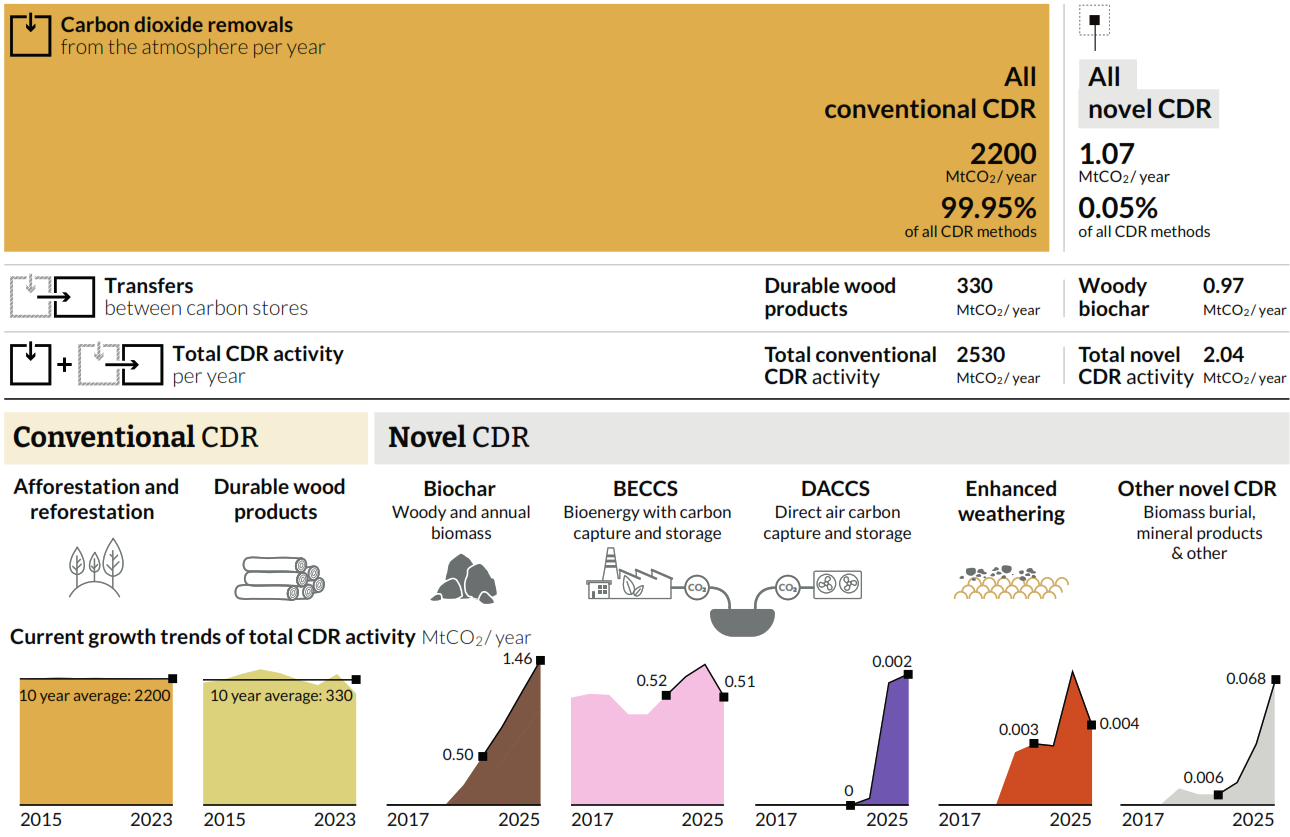
Novel approaches—including direct air capture, enhanced weathering, and biochar—account for only about 2 million tonnes of removal annually, or roughly 0.05% of total CDR activity. While novel methods are growing rapidly, they remain a tiny fraction of overall carbon removal.
3. The world's carbon removal shortfall is growing
One of the report's most striking findings is the widening gap between the amount of carbon removal governments have pledged and the amount required in Paris-compatible climate scenarios.
The report estimates a global CDR gap of 0.3 gigatonnes per year by 2030. That gap grows to 1.2 gigatonnes by 2035 and expands dramatically to 5.2 gigatonnes by 2050.
Because global emissions have continued to rise since the previous edition of the report, the amount of carbon removal needed in future decades has also increased. The authors conclude that without stronger near-term action, the gap will continue to widen.
4. Demand—not technology—may become the biggest obstacle
The report notes that research activity, pilot projects, voluntary carbon market purchases, and startup funding have all expanded over the past several years. Yet the authors warn that future demand for carbon removal has become increasingly uncertain.
Many novel CDR methods still cost hundreds of dollars per tonne of CO2 removed, while most existing carbon markets offer much lower prices. The report also points to policy uncertainty, particularly in the United States, as a potential threat to investment and deployment.
According to the authors, creating reliable long-term demand for carbon removal may now be as important as developing the technologies themselves.
5. The carbon removal industry is heavily concentrated
The report identifies a surprising vulnerability within the emerging CDR sector: concentration.
Most conventional carbon removal credits in voluntary markets originate in Latin America. Biochar and BECCS dominate novel removal activity. Microsoft accounts for the vast majority of purchases of novel CDR credits, while most government demonstration funding is concentrated in the United States, Sweden, and Denmark.
The authors argue that relying on a small number of methods, companies, buyers, and countries creates systemic risks. Diversifying carbon removal technologies, funding sources, and geographic participation could make the sector more resilient and improve its prospects for large-scale deployment.
What to know
Carbon removal is moving from a niche activity toward a growing industry, but the report suggests that deployment remains far behind projected future needs. The next few years could determine whether newer approaches such as direct air capture and enhanced weathering become significant contributors to climate mitigation or remain small-scale demonstrations.